
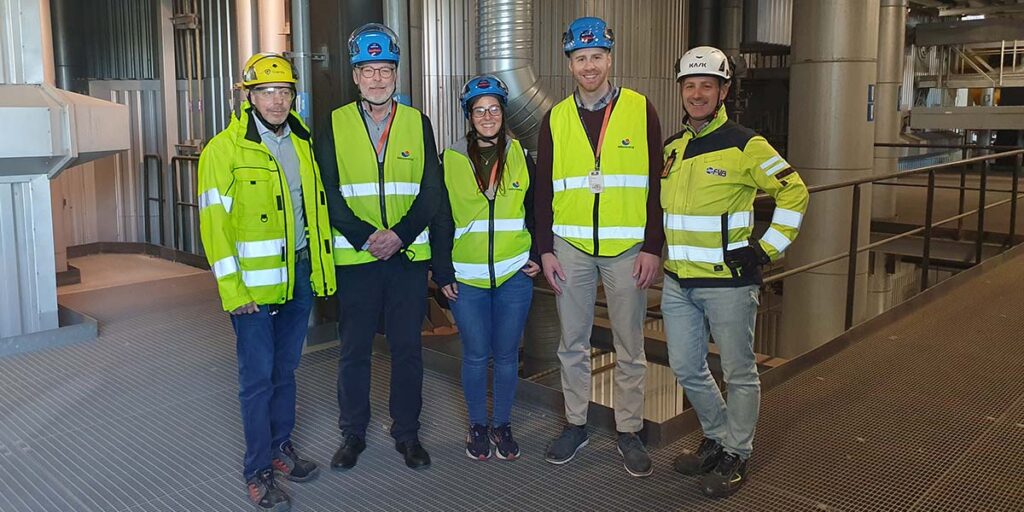
At the Mälarenergi combined heat and power (CHP) plant (Kraftvärmeverket) in Västerås: (from left to right) Magnus Allmyr, asset manager at Mälarenergi; Leif Breitholtz, senior advisor at FVB Energy Sverige; Amber Eckstein, mechanical engineer at FVB Energy US; Zac Olson, mechanical engineer at FVB Energy US; Mathias Edelborg, project manager at FVB Energy Sverige.
In a world where collaboration and innovation drive progress, face-to-face connections remain invaluable. Recently, Zac and Amber, employees from FVB’s Minneapolis, Minnesota office, traveled to Sweden to meet their colleagues at FVB Energy, strengthening relationships and learning firsthand about groundbreaking projects in district energy. Their journey offered not only professional development but also a glimpse into some of the most advanced energy facilities in the world.
Västerås: A Hub of District Energy Excellence
The visit began in Västerås, a city located about 100 kilometers west of the capital, Stockholm, with a population of approximately 160,000. Västerås is renowned for its leadership in sustainable energy and is home to one of the most comprehensive district heating systems in Sweden, owned by Mälarenergi.
Zac and Amber toured Mälarenergi’s waste-to-energy combined heat and power (CHP) plant in Västerås, a facility that exemplifies how communities can transform waste into reliable energy. Equally impressive was their visit to the world’s largest thermal energy storage facility, also connected to the Västerås district heating system. This massive facility stores 80 million gallons (300,000 cubic meters) of hot water at 200°F in repurposed Cold War-era underground caverns that were once used to store fuel oil. Västerås’ district heating system supplies heating to 98% of buildings in the city. Remarkably, the storage capacity is sufficient to heat all customers in Västerås for two weeks.
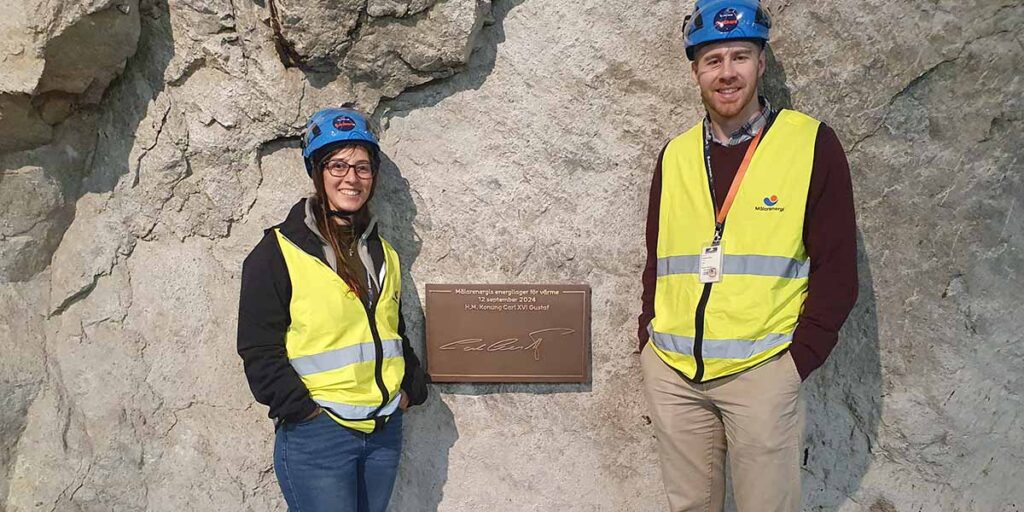
Amber Eckstein and Zac Olson next to the Västerås CHP Plant’s underground thermal energy storage facility’s plaque commemorating the opening of the UTES by His Majesty King Carl XVI Gustaf.
FVB Energy has played a key role in the development of Mälarenergi’s district energy system, helping shape Västerås into a global leader in sustainable heating solutions. This collaboration underscores the importance of technical expertise and long-term partnerships in building resilient energy infrastructure.
Stockholm: Wastewater Heat Recovery, Biofuel Innovation, and Carbon Capture & Storage
From Västerås, Zac and Amber continued to Stockholm, the capital of Sweden, where they explored several pioneering district energy facilities operated by Stockholm Exergi. Their first stop was Hammarbyverket, the world’s largest plant that recovers heat from treated wastewater. With an installed capacity of 768 MMBtu/h (225 MW), Hammarbyverket plays a critical role in Stockholm’s district heating system by using thermal energy that would otherwise be lost to the environment. This facility demonstrates how circular energy solutions can significantly reduce environmental impact while providing reliable heating for urban populations.
Following Hammarbyverket, Zac and Amber visited the “KVV8” CHP plant, Stockholm’s largest biofuel CHP facility commissioned in 2018. KVV8 highlights Sweden’s commitment to renewable energy sources, producing both electricity and heat from sustainable biofuels.
Adjacent to KVV8, they also saw the construction of a pioneering Bio-Energy Carbon Capture and Storage (BECCS) facility. This project represents a bold step toward carbon neutrality: it will capture carbon dioxide from the atmosphere, convert it into liquid form, and transport it to a permanent storage beneath the seabed. The BECCS plant will position Stockholm at the forefront of decarbonization solutions, offering a model for cities worldwide striving to reduce emissions.
“Sweden’s willingness to adopt cutting edge technologies and their ability to effectively and creatively solve the technical challenges that come with decarbonization is a real inspiration,” says Zac.
“Witnessing these technologies being implemented on such a large scale shows that rapid decarbonization is achievable through district energy,” he adds.
FVB Energy played a key role in the design and development of both the Hammarbyverket and KVV8 plants, utilizing their technical expertise in district heating to advance sustainable and reliable district energy systems in partnership with Stockholm Exergi.
Building Bridges Across Borders
Beyond the technical tours, Zac and Amber’s visit highlighted the importance of international collaboration.
“My time in Sweden underscored what FVB brings to projects every day: deep, disciplined expertise in district energy,” says Amber.
“What impressed me most wasn’t a single technology—it was the breadth across disciplines and decades of detail that make innovative systems dependable. From wastewater heat recovery to biofuel CHP, the takeaway was confidence: FVB has the knowledge base to adapt proven approaches and deliver decarbonization that lasts,” she adds.
Meeting colleagues face-to-face allowed them to strengthen professional bonds, exchange ideas, and gain deeper insights into FVB Sweden’s role in advancing district energy.
“I left Sweden grateful—for the engineering, yes, but especially for the openness of our FVB colleagues. Staying connected will turn that openness into shared wins for the communities we serve,” says Amber.